It usually starts with a single notification. You log into your KDP dashboard, expecting to see your royalties, but instead, you see a red bar. “Content blocked.” Or worse: “Account terminated.”
And you’ve just obtained a whole bunch of positive Amazon KDP reviews!
You check the email. It’s a canned response—cold, automated, and utterly final. It mentions “Review Manipulation,” but it doesn’t tell you why or what triggered the bot. You’re left screaming into the void of an unmonitored inbox while your entire income stream vanishes in the time it took to refresh your browser.
No Amazon KDP Reviews = The “Cold Start” Reality.
We’ve all been there. You have a great book, but zero following. You know that without reviews to your book on Amazon, it is harder to compete and get that early traction. So, you turn to the only tools available: Review Exchange platforms, ARC groups, or “Verified Purchase” services.
Let’s be honest: These tools are effective. They provide the “Social Proof” you need to get off the ground.
But in 2026, using them in isolation is like playing Russian Roulette with your livelihood.
The “Statistical Anomaly” – Why You’re Failing the Math Test
Amazon’s bots aren’t “reading” your reviews to see if they are fake. They are looking at Math.
In a natural publishing ecosystem, organic review rates settle between 1% and 2%. This means for every 100 people who buy or download your book, only 1 or 2 will actually leave a review. When you use high-velocity review services without a “data shield,” you create a Statistical Anomaly.
Let’s look at a realistic “Red Zone” scenario: Your brand-new book has been live for 10 days. Your dashboard shows:
- Total Sales: 12
- KENP (Page Reads): 450 (roughly 1.5 full reads)
- Reviews: 35
To a human, that looks like a “successful launch.” To Amazon’s AI, that is a 290% Review-to-Sales ratio. It is mathematically impossible. In the eyes of the bot, there is no “Reader Journey” supporting those stars. No one searched for the keywords, no one spent time on the page, and no one actually read the chapters.
You haven’t just “received reviews”—you’ve left a digital fingerprint of manipulation. You’re failing a probability test that is being graded in real-time. When your historical review data has zero correlation with your actual traffic, you aren’t a publisher; you’re a target.
The Tragedy of “Sloppy” Publishing
When “quick-cash” publishers abuse these tools—dumping 50 reviews on a low-quality book with zero traffic—they don’t just lose their accounts. They poison the well for everyone else.
They trigger “platform-wide” algorithm sweeps that catch legitimate, careful authors in the crossfire. At Bookadillo, we refuse to be collateral damage.
The Bookadillo Standard: Managed Momentum
Our ultimate goal is to help you build a brand so strong you never have to touch a review service again. But until you have that proprietary audience, you must manage your Probability.
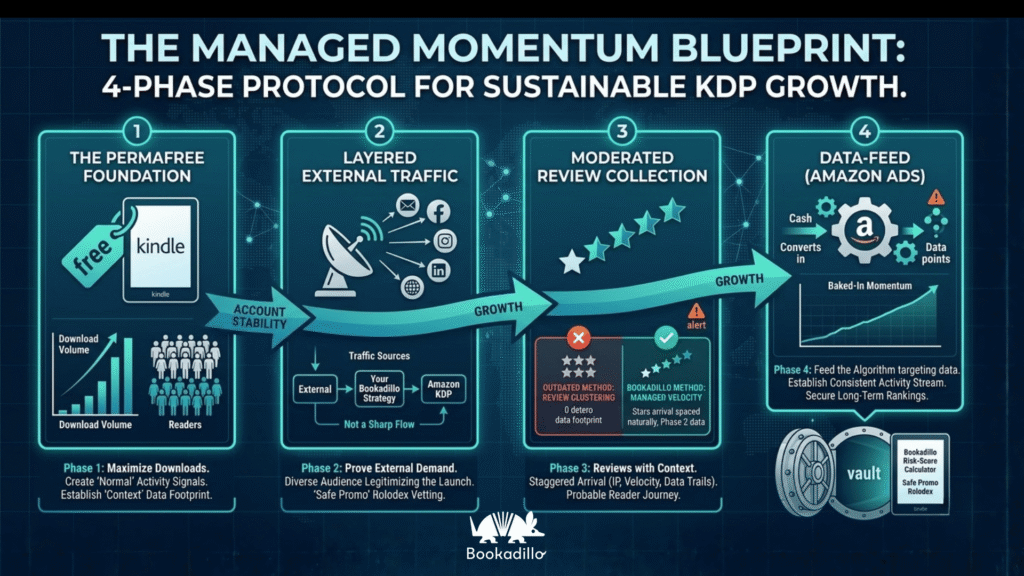
If you are going to use “High-Velocity” tools to survive the Cold Start, you must wrap them in a “Paper Trail” of real reader activity. Here is our 4-Phase Preventive Strategy to lower your risk:
Phase 1: The Permafree Foundation (Normalization)
We don’t launch at full price. We set the ebook to $0.00 across all retailers to force a price-match.
- The Logic: We want thousands of downloads. When a review hits, it’s supported by a massive “noise” of data. To the bot, 10 reviews against 2,000 free downloads looks like a natural, successful organic launch.
Phase 2: Layered External Traffic (Legitimacy)
While the book is free, we push to external promotion sites. We want a “Paper Trail” of readers coming from outside of Amazon. This proves to the bot: “This book has a real audience that exists beyond the KDP dashboard.”
Phase 3: Moderated Amazon KDP Review Collection (Probability Management)
Now, and only now, do you use your review services. But you do it in strict moderation. We never allow review “clusters.” You space them out so they arrive alongside the Phase 1 and 2 traffic.
Phase 4: The Data-Feed (Targeting)
Run Amazon Ads even while the book is free. This feeds the algorithm the targeting data it needs to view your book as a “Quality Asset.” You are effectively “buying” the data footprint that makes your reviews look earned.
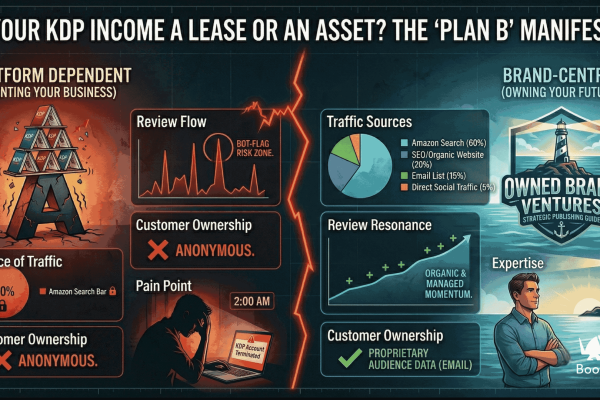
Build a Brand That Can’t Be “Turned Off”
Speed wins short-term positioning, but longevity wins revenue. You can keep playing the “Review Lottery” and hoping your account survives the next sweep, or you can start building a Brand-Centric business that owns its own traffic.
The “Safety Gap” – I’m Building the Solution Today
I’m tired of seeing good publishers get caught in “Review Sweeps” because they didn’t have the data to see the “Bot-Flags” coming.
I am currently in the lab building the “Bookadillo 10-Point Account Safety & Risk-Score Calculator.”
This isn’t a PDF of “tips.” It’s a technical Sheet with built-in formulas that analyzes your actual KDP dashboard data (Sales vs. KENP vs. Reviews) and flashes RED the moment your account enters a “Statistical Anomaly” zone. It tells you exactly when to stop your review services and start driving “Clean Traffic” to save your account.
How to Get It: I am dropping this Risk-Score Calculator—along with my “Safe Promo” Rolodex—to the Bookadillo Waitlist first on launch day.
If you want to be the first to audit your account before the next Amazon algorithm update, secure your spot now and sign up by clicking on the “Join the Waitlist & Secure the Calculator” button below.
Sign Me Up