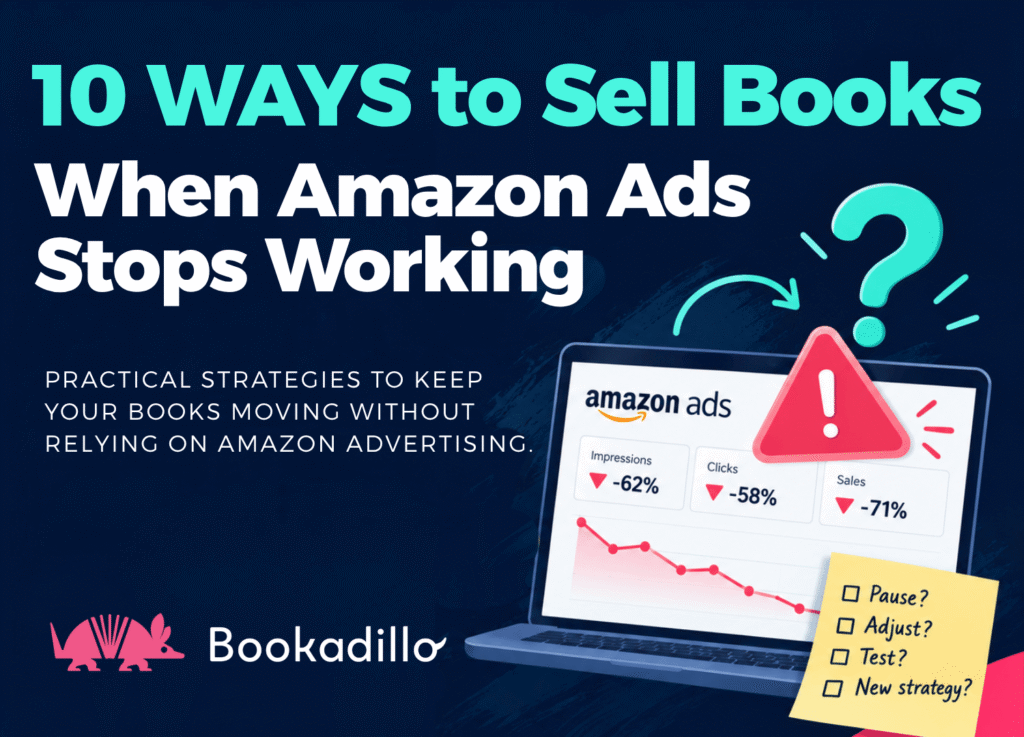
When Amazon ads stop converting, the fix isn’t a bigger budget.
It’s building reader channels Amazon doesn’t control: an email list, an ARC team (Advanced Reader Copy), a website, and content that reaches readers directly. These 10 strategies cover exactly that, and the right mix depends on what you’re actually trying to build..
Quick Answer
- Amazon ads getting worse usually means you’re too dependent on one channel, not that your book or budget is the problem
- The fix is building reader channels you own: email list, ARC team, your own website, direct content
- Not all 10 strategies below fit every author. Some depend on writing under your own name, others work fine under a pen name
- Getting clear on why you’re publishing decides which strategies are actually worth your time
You check the dashboard. Nothing moves. You raise your budget. Still nothing.
That’s the moment most authors realize Amazon ads were never really growing their business. Ads were just renting a few sales at a time.
But here’s the part that actually hurts more.
Even when the ads did work, you had to start from zero on the next book anyway.
New launch. New ad campaign. New scramble for reviews. New audience to find, all over again. The book before it never left you anything to build on. No list. No readers waiting. Just another blank page and another ad account draining your budget.
That’s not a marketing problem. That’s a system problem. And it’s fixable.
Picking the right strategy matters less than knowing why you’re picking it. Stick with this to the end, because there’s a way to find that out too.
The 10 Ways to Sell Books When Amazon Ads Stop Working
The authors who stop feeling stuck aren’t the ones who found a better ad strategy. They’re the ones who stopped depending on ads and started building something that carries over from one launch to the next.
Here are 10 ways to do that. A few of them work differently depending on the kind of publisher you are. If you write under your own name and want the book to grow into speaking, coaching, or another business down the line, lean into the ones that put you out front. If you publish under a pen name, or run several pen names at once, skip those and lean harder on your list, your ARC team, and your website. None of those need your face attached.
1: Show Up Where Your Readers Already Are
Amazon only sees a click. It doesn’t know your reader. Post where your readers actually spend time, talk about your ideas, and send people to your own website instead of another product page. This works under a pen name too. Post as the brand, not the person.
2: Turn Your Book Into a Way to Grow Your Email List
Give away a chapter or a short resource for an email address. That list is the one thing Amazon can never take from you, and it’s the first piece of not starting from zero next time.
3: Launch With Email, Not Ad Spend
A pre-order push, a street team, a follow-up after launch. Email consistently outsells cold ads once your readers already trust you.
4: Build an ARC Team That Actually Recommends Your Book
Find readers who care about your topic. Give them an easy way to leave honest feedback. Their voices reach newsletters, podcasts, and reader groups that Amazon search never touches.
One real result. A client tested this before committing to a full launch system. In three days, a modest ad budget on a niche nonfiction guide brought in 137 real, engaged email leads at $2.20 per lead, an 80% form completion rate, and a 4.78% click-through rate, more than double what’s usually considered strong. That was enough signal to move into a full 90-day ARC pipeline.
The system didn’t just work once. Once the full pipeline was live, cost per lead dropped to $1.22 and total leads climbed past 470. Nothing was rebuilt from zero for the next phase. The same engine kept running and got more efficient the longer it ran.
5: Get Booked on Podcasts
Your ideal reader is listening to something right now. One good interview, talking about your subject instead of pitching your book, can bring in more readers in a week than months of average ads. This one needs your actual voice and face out front, so it fits an author building a personal brand far better than one writing under a pen name.
6: Partner With People Who Already Have Your Reader’s Attention
Newsletter writers, community leaders, bloggers. Offer them a free excerpt or a resource worth sharing, and you’re in front of the right person directly.
7: Write Content That Answers Your Reader’s Real Questions
Posts, articles, videos, anything that answers what your reader is already searching. Do it consistently and you become the name they trust before they ever open Amazon.
8. Build a Simple Path From First Contact to Buyer
Right now, a reader either buys on impulse or forgets your book completely. Give them a path instead: first contact, a reason to stay, a moment they’re ready to buy.
9. Sell More Than Just the Book
A workshop, a community, a resource your reader actually wants. One product means one way to earn. Your own website means several. This works best if the book is meant to open the door to a bigger business under your own name, like coaching or courses. If you’re publishing under a pen name purely for the writing, a bundle of extra books or box set does the same job instead.
10. Run It All on One Schedule
Marketing to your list, reviews to your ARC team, content to your blog, sales to your website. Check it every few months and scattered tactics turn into something you can count on.
Which Strategy Is Actually Yours?
You’ve got ten strategies now, and every one of them beats starting from zero on your next launch. Not all ten are yours to run, though.
Picking the right ones starts with a question most authors skip. Why are you publishing in the first place? What does success actually look like for you? A full-time income. A brand that opens the door to speaking or coaching. A backlist that keeps selling long after this launch is over. Each answer points to a different mix of the ten.
If you already know your answer, you know where to start.
If you don’t, book a Publishing Clarity Call. It’s a no obligation 30 minute call with me.
Before the call, you’ll answer two quick questions:
1. What made you book it
2. What you want clear direction on by the end?
There’s also an optional spot to share a link to your book, so the call can dig into your specific situation instead of general advice
The conversation goes wherever it needs to go. Afterward, you’ll get a short summary of what came up and a clear set of next steps, whether that’s one of the strategies above, one of our services, or a resource or person better suited to help than we are.