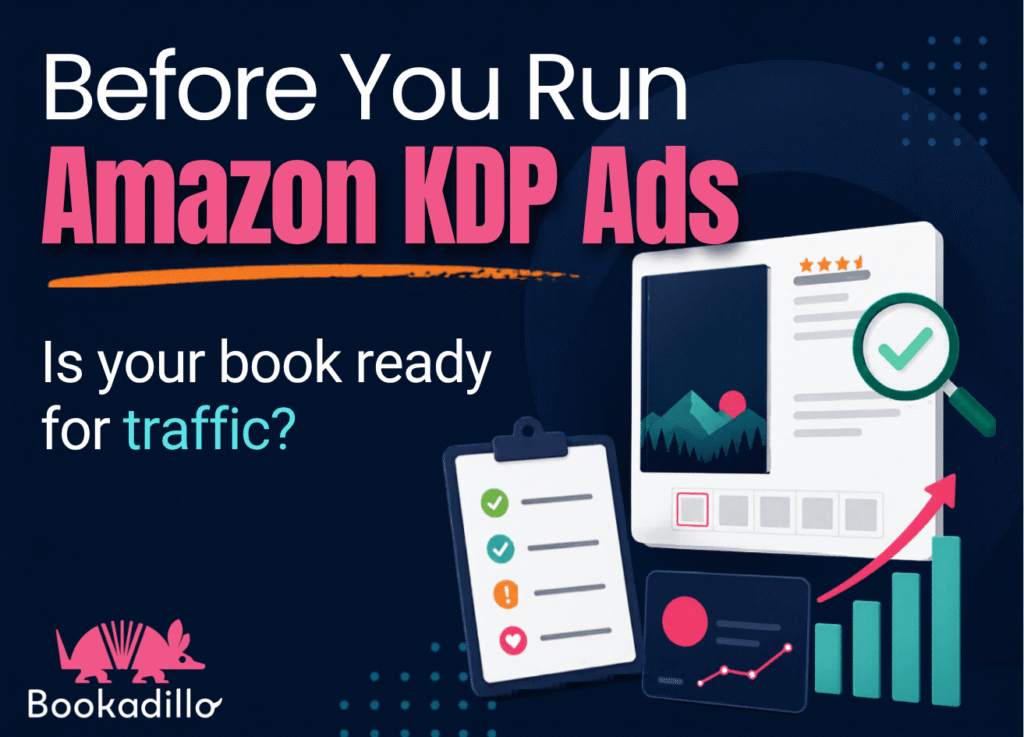
By the time you start thinking about Amazon KDP ads, your listing may already be carrying problems that ads cannot fix.
Your book is live. The listing is published. The next natural thought is usually, “How do I get more traffic to this?”
That makes sense. Ads can be useful when you want to test visibility, keywords, audience response, and sales potential. They can help you understand whether your book is attracting the right readers and whether your listing can turn attention into sales.
But before you spend more money, there is one question worth asking:
Is your book actually ready to receive Amazon KDP ads traffic?
This is something I often look for when reviewing Amazon KDP ad listings for clients.
Before I think about whether ads should be scaled, adjusted, or tested further, I want to understand whether the book is giving the campaign something strong enough to work with.
Because if your listing is unclear, ads may not solve the problem. They may simply make the problem more expensive.
Amazon KDP Ads Do Not Fix an Unclear Listing
Amazon KDP ads can send more people to your book. They can help test keywords, audience interest, clickability, and conversion. But they do not automatically make your book more desirable, more understandable, or more competitive.
They mostly send traffic to what already exists.
If your cover does not communicate clearly, ads will expose that. If your title does not make the promise obvious, ads will expose that. If your book is sitting between too many markets, ads will expose that. If your description explains what is inside the book but does not help the reader understand why they should care, ads will expose that too.
This is why an ad problem is not always an ad problem.
Sometimes it is a positioning problem. Sometimes it is a packaging problem. Sometimes it is a buyer clarity problem.
And that is actually good news, because those things can usually be improved before you spend more money trying to force the ads to work.
High Advertising Cost Of Sales (ACOS) Is Not Always a Campaign Problem
If your ACOS is high and your ad spend keeps rising without meaningful profit, it is easy to assume the campaign is the issue.
You may start lowering bids, changing keywords, pausing targets, testing new campaign structures, or trying a different targeting approach. Those adjustments can help, especially if the campaign setup genuinely needs work.
But before assuming the ads are the main problem, look at the listing itself.
Is your book clearly positioned? Does the cover compete well beside similar books? Does the title make sense quickly? Does your description sell the book, or does it only summarize what is inside? Is there enough trust for someone to click, inspect, and buy?
If your listing is not ready to convert, paid traffic becomes harder to understand. You may get clicks, but not enough sales. You may get impressions, but not enough interest. You may keep adjusting the campaign when the real issue is that the listing is not ready for traffic yet.
That is where a lot of money gets wasted.
Ad Readiness Starts Earlier Than Most Publishers Think
You do not need to have every ad detail planned before the book is written. But you should start thinking about ad readiness earlier than the moment you launch the campaign.
By the time your book is live, many of the things that affect ad performance have already been decided.
The topic has been chosen. The buyer promise has been shaped. The cover direction has been approved. The title and subtitle are locked. The categories and keywords have been selected. The description has been written. The price has been set.
At that point, your listing is asking for traffic.
So the real question is not only, “Can I run ads for this book?”
The better question is:
Is this book giving ads something strong enough to work with?
You cannot know for sure whether ads will work until you test. But you can often tell whether your book is ready to be tested.
That difference matters.
You do not need everything to be perfect before running ads. But you do need the listing to be clear enough that the test can give you useful information.
If the offer is confusing, the ads may not tell you whether the book has potential. They may only tell you that buyers do not understand what they are being shown.
The Three Things to Check Before You Spend More on Ads
Before spending more money on Amazon book advertising, I would look at three things first: demand, positioning, and conversion.
1. Demand
Are readers already looking for or buying this kind of book?
This does not mean your book has to copy what already exists. But there should be some visible proof that readers care about the topic, problem, genre, experience, or outcome your book is offering.
If there is no clear demand, ads can become a very expensive way to test whether anyone wants the book at all.
For nonfiction, this could mean checking whether readers are actively searching for the problem, transformation, or topic your book addresses. For fiction, it could mean understanding whether the genre expectations, emotional hooks, tropes, and reader appetite are clear enough to support paid traffic.
The stronger the demand signal, the easier it becomes to understand what your ads are testing.
2. Positioning
Is it immediately clear who your book is for and why it matters?
This is where many books struggle. The idea may be good, but the market lane is not clear. The book may be trying to speak to too many people at once. Or the title, subtitle, cover, and description may not be working together to communicate one strong buyer promise.
When positioning is unclear, everything downstream becomes harder.
Your cover becomes harder to judge. Your keywords become less focused. Your description becomes harder to write. Your categories become harder to choose. Your ads become harder to test.
A book can be thoughtful, useful, or well-written and still struggle if the buyer cannot understand the promise quickly enough.
On Amazon, buyers usually do not stop and study a listing carefully at first. They glance, compare, and decide whether the book deserves more attention.
That first moment matters.
3. Conversion
Does your listing give the buyer enough trust to click, inspect, and buy?
A book can have demand and still struggle if the listing does not convert. The cover may not feel competitive. The description may be too vague. The price may not match the perceived value. The reviews may be too low for the category. The Look Inside may not support the promise.
Ads can bring attention, but the listing still has to do the work of turning that attention into a sale.
This is why listing optimization matters before serious ad spend.
A stronger listing does not guarantee profitable ads. Nothing can guarantee that. But it does give the campaign a better chance of producing useful data and conversion to sales.
The Pattern I Keep Seeing When I Audit Amazon KDP Book Listings and Talking with Self-Publishers
Your book may have real effort behind it. The idea may have potential. You may be serious and willing to invest in growth. But if the book is being pushed toward ads before the listing is fully clear, the campaign can end up taking the blame for a problem that started much earlier.
The issue is not always that the book is bad.
Sometimes the issue is that Amazon and the buyer do not know where to place it.
That is an important distinction.
Because if the book is not clear enough yet, more traffic may not solve the problem. It may only make the confusion more expensive.
A Simple Amazon KDP Ads Readiness Check
Before you spend more on ads, take a quick look at your book and ask:
- Is there clear reader demand for this kind of book?
- Is the buyer promise obvious from the cover, title, and subtitle?
- Does the book have a clear market lane?
- Does the listing explain why this book is for the right reader?
- Does the cover compete well beside similar books?
- Does the description help the buyer decide?
- Is there enough trust for someone to click, inspect, and buy?
- Do I know what I am actually testing with ads?
If you cannot answer these clearly, it may not mean the book should never run ads.
It may simply mean the listing needs to be cleaned up first.
Want a Quick Look at Your Listing?
If you are unsure whether one of your current books is actually ready for Amazon KDP ads, you can email us at hello@bookadillo.com
Send the listing and we can take a quick look at what we would check first before sending more traffic to it.
And if you want to join the bigger conversation around ARC KDP strategy, book listing clarity, account safety and account termination, going wide, and building a stronger publishing business on and off Amazon, you are welcome to join our SKOOL community.
Join Amazon KDP Unfiltered Here
The goal is not to spend more on ads.
The goal is to make sure your book is ready before you ask ads to do the heavy lifting.