The Hidden File-Size Cost
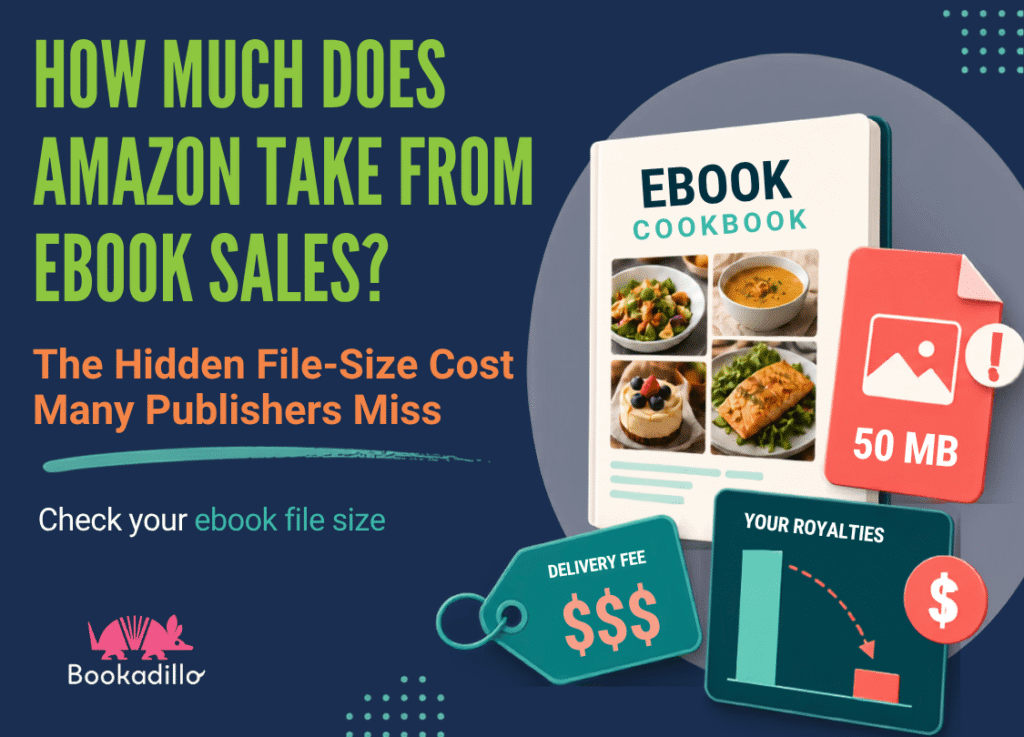
Amazon’s share of an ebook sale depends on your royalty option, list price, marketplace, taxes, and applicable delivery costs. For eligible sales under KDP’s 70% royalty option, the final processed ebook file size can affect the delivery cost deducted from the sale.
That means an unnecessarily large, image-heavy ebook may quietly leave you with lower royalties, even when your selling price stays exactly the same.
This is particularly relevant for cookbooks, children’s books, illustrated nonfiction, activity books, and Print Replica ebooks.
What Publishers Need to Know About
- Large image-heavy ebooks may carry higher delivery costs under applicable royalty terms.
- File optimization should begin with the source images, not only the finished ebook.
- Excessive compression can damage image quality and weaken the reader experience.
- Always verify the processed file size, delivery cost, and estimated royalty shown inside your own KDP account.
- The uploaded file size and Amazon’s final processed file size may not be identical.
What Happened With One Image-Heavy Cookbook
We recently worked on a cookbook that had been converted into a Print Replica ebook.
That format made sense for the project because the page layout and food photography were central to the reader experience. The ebook needed to preserve its original design rather than reflow like a standard text-based Kindle book.
However, the finished file had reached approximately 50.4 MB and was displaying a large-file warning inside KDP. The publisher was also concerned that paid ebook sales were producing little or no royalty.
At first, the solution seemed straightforward: compress the file. But for a cookbook, aggressive compression can create a different problem. Food photographs can become blurry, dull, or visibly pixelated. The file may become smaller, but the customer receives a weaker product.
We needed to reduce the Kindle ebook file size without damaging the experience readers were paying for.
Instead of relying only on final-file compression, we went back to the source images. We reduced the size of the individual images, replaced the heavier versions inside the working document, reformatted the ebook, and then applied another careful round of compression.
During that process, the file came down from approximately 50.4 MB to around 10.1 MB, and the large-file warning disappeared.
The goal was not to produce the smallest file possible. It was to remove unnecessary weight while preserving the image quality and layout of the cookbook.
The Hidden Cost Inside a Large e-book File
For eligible U.S. sales under KDP’s 70% royalty option, Amazon publishes a delivery rate based on the final processed ebook file size. The current U.S. rate is listed as $0.15 per MB.
Using that rate as a theoretical illustration:
| Example file size | Illustrative delivery cost |
| 50.4 MB | $7.56 |
| 10.1 MB | Approx, $1.52 |
| Difference | Approx. $6.04 |
This example makes the possible impact easier to see.
A book can sell at the same list price and still leave the publisher with a very different result if one version carries substantially more file weight. For image-heavy books, KDP delivery fees can become a meaningful part of the royalty calculation.
Important note: These figures are theoretical, educated estimates based on Amazon’s published U.S. delivery rate, the file sizes observed during this project, and our experience with image-heavy ebooks. They are included to illustrate how file size may affect profitability, not to predict the exact royalty for a particular book.
Amazon uses the final processed file size, and actual amounts may vary by marketplace, pricing, taxes, royalty eligibility, and other factors inside KDP. Always confirm the delivery cost and estimated royalty shown in your own account.
An Amazon KDP royalty calculator may help you estimate earnings, but it is still important to review the information displayed in your own pricing setup. The file you upload and the final file Amazon processes may not always be the same size.
Why Compression Alone Was Not the Answer
Reducing an ebook file is not simply a matter of selecting the strongest compression setting available.
For a visual book, you also need to protect:
- Image clarity
- Text readability
- Page layout
- Device display quality
- The overall reader experience
If you compress the completed file too heavily, you may reduce its size while weakening the product itself.
A better process begins with the source material. Check whether the original images are much larger than their displayed dimensions require. Resize and optimize them before they are placed into the working document. Review the export settings, rebuild the ebook, and inspect the finished file after compression.
The aim is not maximum compression. The aim is a cleaner, more efficient file that still looks professional.
That distinction matters most for cookbooks, children’s books, visual guides, activity books, and other ebooks where the images are part of the book’s value.
What to Check Before You Blame Pricing or Ads
If you are wondering why your KDP royalties are so low, do not immediately assume the problem is your advertising or list price.
Review the following inside your KDP account:
- The final processed ebook file size
- Any large-file warning
- The delivery cost displayed on the pricing screen
- The estimated royalty at your current price
- The royalty option selected
- Whether your source images are larger than necessary
- Whether the file can be reduced without visible quality loss
You should also compare the completed ebook with the original working document. If the finished file is significantly larger than expected, inefficient image handling or export settings may be contributing to the issue.
File size is not the only reason an ebook royalty may be lower than expected. Pricing, marketplace differences, taxes, royalty eligibility, price matching, and other Amazon ebook fees may also affect the final amount.
Does File Size Affect Paperback Royalties Too?
Not in the same way.
KDP does not apply a per-megabyte delivery charge to paperback sales. Paperback royalties are calculated using the applicable royalty rate, list price, and physical printing cost.
Printing cost is influenced by factors such as:
- Page count
- Ink type
- Whether the interior is black and white or color
- The Amazon marketplace where the book is ordered
- The selected print specifications
A large paperback PDF can still create slower uploads, processing problems, or print-quality concerns. However, reducing a paperback file from 50 MB to 10 MB would not, by itself, increase the royalty per sale.
For paperback profitability, the more useful questions are often:
- Is the page count higher than necessary?
- Is a color interior essential?
- Does the list price leave enough room after printing costs?
- Are unnecessary pages increasing production cost?
- Are the chosen print specifications appropriate for the book?
The ebook issue discussed in this article should not be applied directly to paperback royalties.
Why and How I Look Beyond the Surface of a KDP Listing
I started working behind the scenes of KDP accounts as a Virtual Assistant more than six years ago.
In the beginning, my role was largely administrative. But the more accounts and publishing projects I managed, the more I saw that many problems could not be solved efficiently by simply sending the asset back to the formatter, cover designer, or writer.
A low royalty may not only be a pricing issue. An upload error may not only be a formatting issue. A blocked book may not only be a content issue. A listing receiving traffic but not converting may not only be an advertising issue.
Sometimes the real problem sits between production, files, metadata, pricing, listing setup, and the KDP backend.
Over time, I developed the skills to investigate those connections, identify the likely source of a problem, and give the creative team more precise instructions. This reduced unnecessary back-and-forth and allowed us to resolve issues more accurately.
Today, I help independent publishers identify the operational, technical, and strategic issues that may delay a launch, reduce profitability, create KDP concerns, or quietly weaken a book’s performance.
An oversized ebook file is only one example of the problems that can remain invisible until someone looks beyond the surface of the listing.
A Quick Note for Publishers of Visual e-books
Image-heavy ebooks will naturally be larger than text-only books. A large file is not automatically a bad file, and reducing it to the lowest possible number should not be the goal.
The better question is whether the file is carrying unnecessary weight.
If every image is needed, properly sized, and contributing to the reader experience, the larger file may be justified. But if high-resolution source images were placed into the document without optimization, the file may be creating avoidable delivery costs.
The right balance is a file that delivers efficiently without sacrificing the quality of the book.
Want Me to Take a Quick Look at Your Amazon Listing?
File size is only one of the details that may quietly affect your book’s performance or profitability.
I am currently offering quick Amazon listing audits to help publishers identify what may be worth improving first. I review areas such as positioning, metadata, pricing, buyer clarity, file setup, listing presentation, and other issues that may be limiting the book behind the scenes.
If your royalty figures do not make sense, your ebook is displaying a large-file warning, or you simply want another experienced set of eyes on your listing, email me at hello@bookadillo.com
Send your Amazon book link and a short note about your concern. I’ll take a quick look and point you toward the first areas I would examine.
Sources
This article was reviewed against Amazon KDP’s current official guidance on:
- Amazon KDP eBook Royalties and Delivery Costs
- Amazon KDP Digital Book Pricing and Royalty Options
- Amazon KDP Paperback Royalty Calculation
- Amazon KDP Paperback Printing Costs
- Amazon KDP Royalty Calculator
- Amazon KDP Pricing and Royalty Troubleshooting